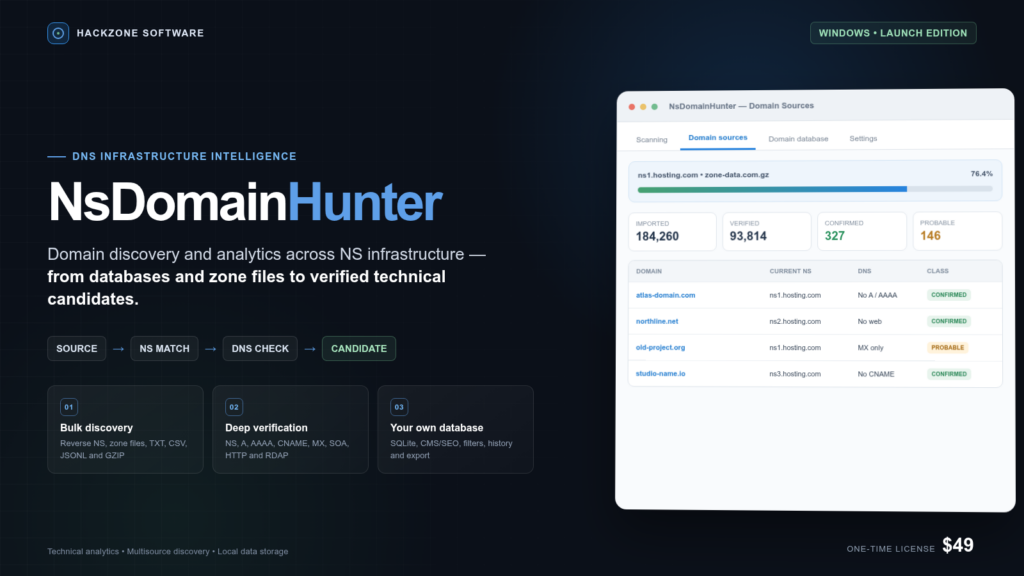
NsDomainHunter collects domain candidates from reverse-NS providers, zone files, and local datasets, verifies their current DNS configuration, and highlights domains showing technical signs of unused or incomplete hosting configuration.
The application is designed for DNS researchers, SEO professionals, hosting administrators, infrastructure analysts, and domain portfolio owners. It does not treat a missing website as proof of availability: every result is verified, classified, and assigned a confidence level.
What NsDomainHunter does
- Discovers domains through reverse-NS APIs or imported datasets.
- Confirms whether the selected name servers are still delegated.
- Checks A, AAAA, CNAME, MX, SOA, and TXT records.
- Separates active websites, mail-only domains, stale source records, and DNS errors.
- Checks HTTP/HTTPS responses, redirects, page titles, and CMS indicators.
- Retrieves available registration information through RDAP.
- Calculates a local on-page SEO score.
- Stores results and history in a local SQLite database.
- Provides filtering, bulk selection, copying, and CSV/JSON export.
Domain sources
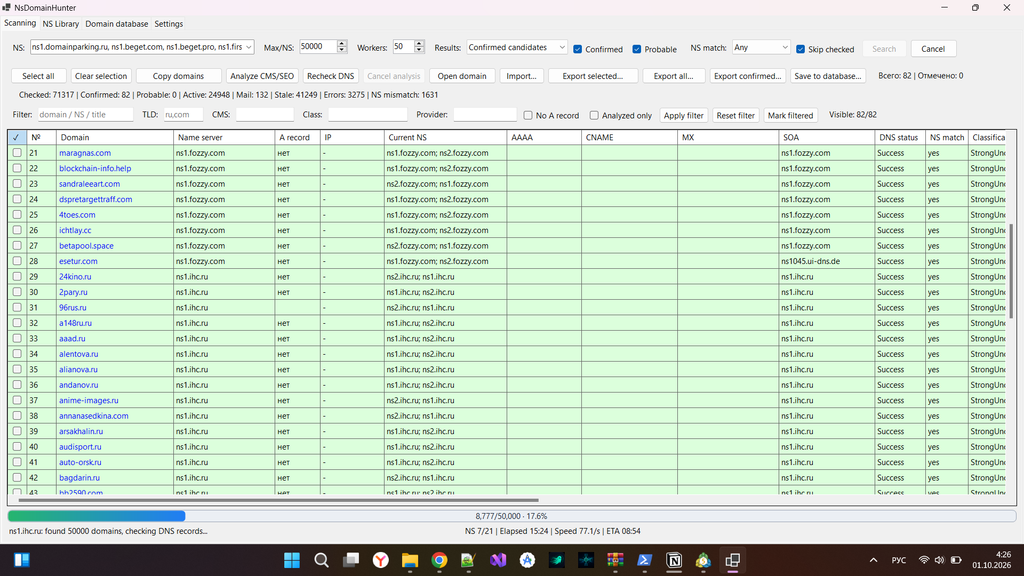
Reverse-NS providers
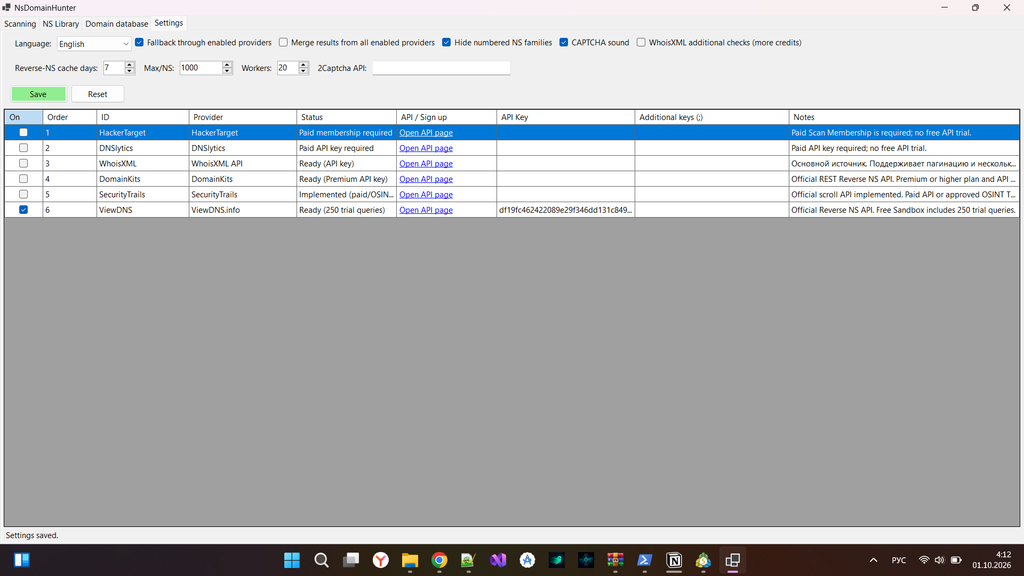
NsDomainHunter uses a modular provider chain with fallback and optional result merging. Availability, quotas, pricing, and acceptable use are controlled by each third-party provider.
Zone files and local datasets
The Domain Sources workspace supports streaming import of:
- BIND zone files;
.zoneand.txtfiles;- CSV files;
- JSON Lines datasets;
- GZIP-compressed sources;
- one-domain-per-line lists.
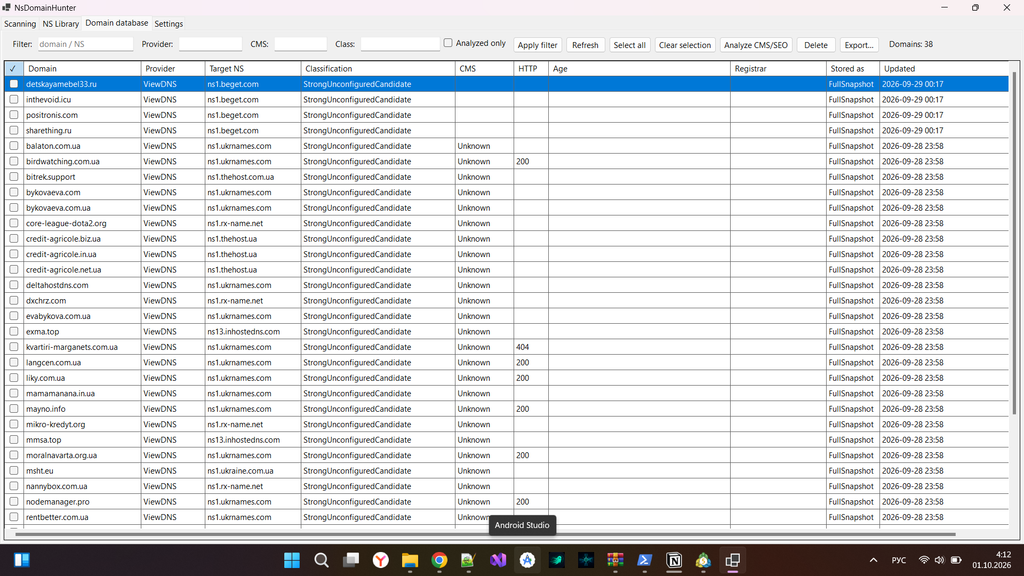
When NS records are available, NsDomainHunter filters by the target name server while reading the source. This avoids storing hundreds of millions of unrelated records.
Supported import features include:
$ORIGINdirectives;- absolute and relative DNS names;
- repeated BIND record owners;
- IDN and Punycode normalization;
- matching numbered NS families such as
ns1/ns2/ns3; - cancellation and resume;
- SQLite deduplication;
- batch verification of large datasets.
The application includes quick links to ICANN CZDS, Rapid7 Project Sonar, OpenINTEL, and public ccTLD source catalogs.
DNS verification
- For every candidate, NsDomainHunter checks:
- current authoritative name servers;
- exact or family-based NS matching;
- IPv4 A records;
- IPv6 AAAA records;
- CNAME records;
- MX records;
- SOA records;
- TXT records;
- NXDOMAIN, SERVFAIL, timeout, and other DNS states.
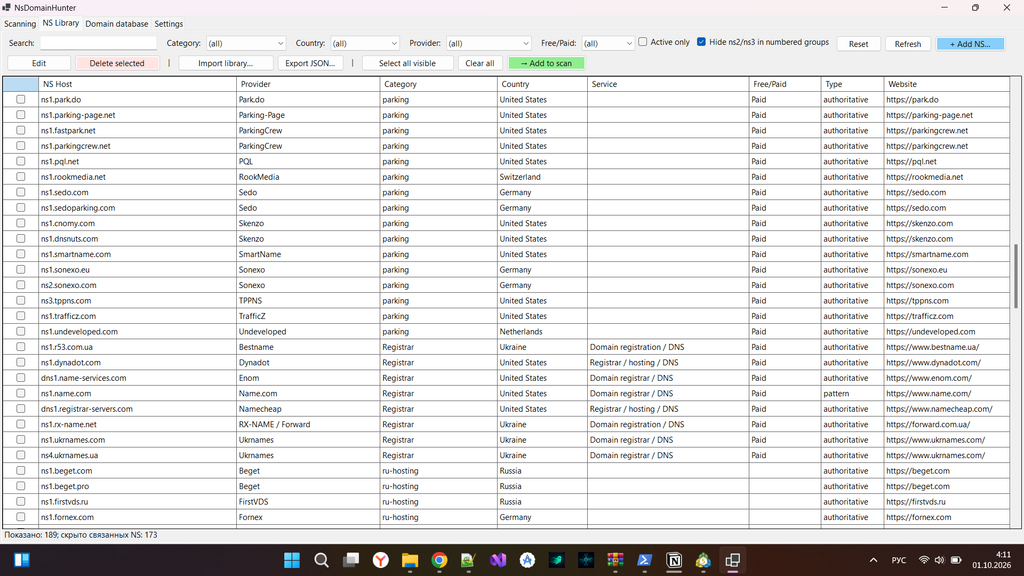
The verification engine is staged: domains that clearly fail the target-NS test are rejected before unnecessary queries are performed.
Result classification
Strong Unconfigured Candidate
A strong technical candidate. Current NS delegation matches the target infrastructure, while the main indicators of configured web hosting are absent.
Probable Unconfigured
A probable candidate. Several signals match the intended profile, but the evidence is incomplete or another service is still present.
Active
Address records, CNAME records, or an active web resource were detected.
Mail Only
Web hosting indicators are absent, but the domain is still configured for email.
Delegation Mismatch
The current name servers no longer match the selected infrastructure.
Stale Source / DNS Error
The source record is outdated, or the live state could not be verified reliably.
CMS and SEO analysis
CMS/SEO analysis runs only for selected domains, keeping the discovery pipeline fast.
CMS indicators are available for WordPress, 1C-Bitrix, Joomla, Drupal, OpenCart, MODX, DLE, Shopify, Wix, Tilda, Webflow, PrestaShop, Magento, Ghost, Next.js, Nuxt, TYPO3, Blogger, and Squarespace.
The local on-page SEO score evaluates:
- page title;
- meta description;
- H1;
- canonical URL;
- viewport;
- HTML language attribute;
- HTTPS;
- HTTP response status;
noindexdirectives.
Authority, backlink, and referring-domain metrics require an external SEO API. NsDomainHunter leaves those values empty instead of fabricating results.
Permanent domain database
Selected results can be stored as either a domain-only record or a complete DNS/CMS/SEO snapshot. Stored information may include:
- source and target NS;
- classification and confidence;
- DNS records and check date;
- HTTP and CMS observations;
- registrar and registration dates;
- SEO observations;
- recheck history.
The database can be filtered by domain, TLD, source, CMS, classification, and analysis status.
Productivity features
- colored progress indicator;
- completion percentage, speed, and ETA;
- live result updates;
- bulk selection and copying;
- open domain in browser;
- CSV/JSON import and export;
- resumable processing;
- skip previously checked domains;
- English interface by default;
- Russian and Ukrainian interface options.
Privacy
Core results, settings, history, and imported datasets are stored locally. Network requests are sent only to the DNS, RDAP, HTTP, and API services selected by the user.
System requirements
- Windows 10 or Windows 11, 64-bit;
- Internet connection;
- 4 GB RAM minimum;
- sufficient storage for imported datasets and SQLite;
- no separate .NET installation for the self-contained build.
An SSD and additional free storage are recommended for large TLD zone files.
Important notice
NsDomainHunter is a technical analytics tool. A candidate classification does not establish ownership, authorization, or a guaranteed ability to add a domain to any hosting panel. Users are responsible for complying with applicable law and the terms of registries, APIs, hosting providers, and data sources.